

How to Automate Your Sales Pipeline from Lead to Close means using CRM workflows, rules, integrations, and AI-assisted processes to capture leads, qualify and route them, create follow-up tasks, update stages, manage proposals and approvals, and coordinate closing and onboarding. A pipeline commonly spans seven stages from prospecting through post-sale follow-up.
- Sales pipeline automation uses CRM workflows, rules, integrations, and AI-assisted processes for repeatable tasks.
- A standard pipeline can include prospecting, qualification, discovery, proposal or quote, negotiation, closing, and post-sale follow-up.
- One startup setup example costs about $175 per month for three users.
- The cited source recommends at least closed deals for reliable AI lead-scoring predictions.
- Sales-cycle speed can be measured from deal creation to closed won; one illustration compares days with days.
How to Automate Your Sales Pipeline from Lead to Close: What does sales pipeline automation include from initial lead capture through closing a deal?
Sales pipeline automation uses CRM workflows, rules, integrations, and AI-assisted processes to handle repeatable tasks as leads and deals move through the pipeline. How to Automate Your Sales Pipeline from Lead to Close starts with capturing a lead, creating a record, assigning ownership, and scheduling the next task. How to Automate Your Sales Pipeline from Lead to Close also means reducing manual input for reminders, follow-up, stage updates, handoffs, data syncing, reporting, quotes, invoices, and renewal reminders.
A pipeline commonly moves through prospecting, qualification, discovery or needs analysis, proposal or quote, negotiation, closing, and post-sale follow-up. How to Automate Your Sales Pipeline from Lead to Close should preserve clear outcomes: a deal can be won, lost, or canceled. After a win, the workflow can create follow-up lists for fulfillment, billing, or onboarding. Integrated systems give sales and marketing teams visibility into the customer’s position, next action, and responsible person.


Which sales pipeline stages and tasks should be automated first, and what criteria should determine the order?
Early sales automation should target repetitive, clearly defined work that busy people can easily get wrong. How to Automate Your Sales Pipeline from Lead to Close is to begin with lead capture and first-response alerts, then add follow-up sequences and deal-stage tracking. How to Automate Your Sales Pipeline from Lead to Close should next cover routing, task creation, reminders, stale-deal alerts, and closed-won handoffs before more advanced AI functions.
Use bottleneck impact and implementation size to set priorities, then use historical deal duration, conversion rates, and activity patterns to set thresholds and assignment criteria. Data-entry-heavy processes, pipeline stalls, manual coordination with third-party systems, and data silos are signs of bottlenecks. Audit the three biggest pipeline leaks and automate one workflow at a time. Keep discovery nuance, objection handling, negotiation, account strategy, and sensitive communication human-led.
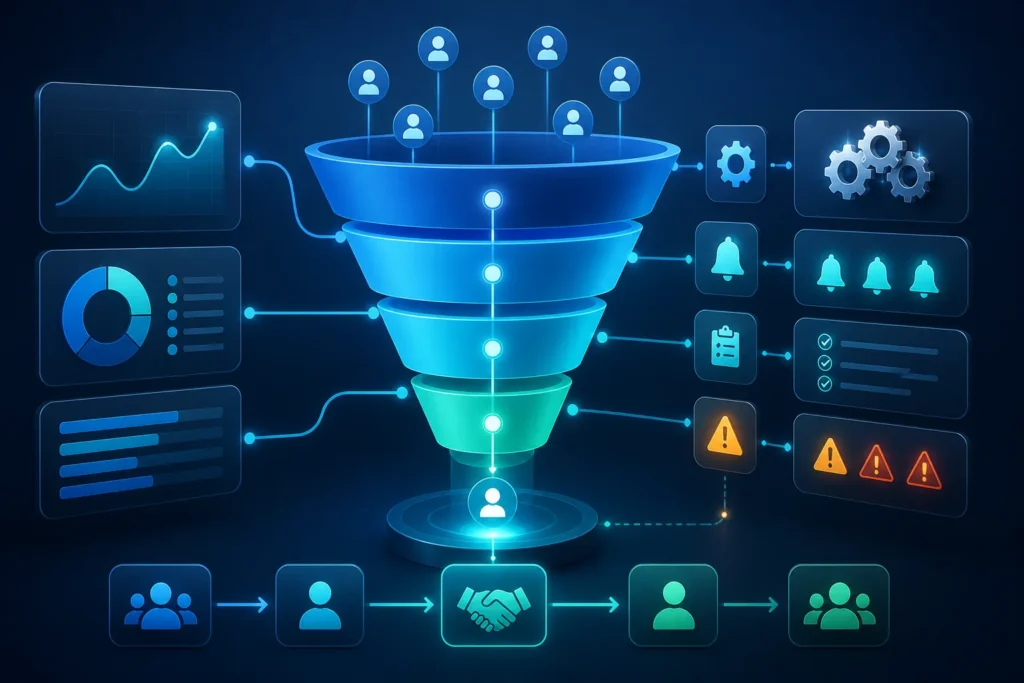
How do you set up an automated workflow for lead capture, qualification, assignment, follow-up, deal-stage updates, and closing?
Workflow setup should begin by mapping the current sales process and identifying where deals stall. How to Automate Your Sales Pipeline from Lead to Close is to define each trigger and action before changing CRM workflows. How to Automate Your Sales Pipeline from Lead to Close can then capture a lead from a form, ad, chat, or inbound source, create a CRM record, assign an owner, notify the rep, and create the first sales task.
Qualification rules can assess need, budget, authority, fit, and intent, while lead scoring ranks prospects for sales attention. Attach a predictable next action to every stage, such as demo preparation, a recap email, proposal follow-up, or a call task. Stage criteria should define the actions, milestones, and qualifications required before advancement. Add proposal, quote, approval, and closing paths, with manual review for complex or high-value deals. Test in a limited scope and document recovery for missing data, duplicate records, missed triggers, and manual review.

What CRM features, integrations, and lead data are required to automate a sales pipeline?
A suitable CRM needs customizable pipelines, workflow triggers and actions, lead scoring, task management, contact and lead records, reminders, reporting, forecasting, and integrations. How to Automate Your Sales Pipeline from Lead to Close depends on connecting forms, advertising platforms, email, calendars, meeting tools, internal communication, quoting, and onboarding systems. How to Automate Your Sales Pipeline from Lead to Close should centralize capture in one CRM rather than separate inboxes, spreadsheets, or notebooks.
Useful records can include industry, company size, job title, role, location, challenges, goals, source, product interest, territory, engagement, and buying behavior. Automatically log emails, calls, meetings, chats, website visits, email opens, and content downloads. Plan deduplication, consent records, privacy review, and data-quality checks; the supplied claims don't specify a particular compliance framework or legal standard. Rule-based scoring is recommended when there are fewer than closed deals; the cited source recommends at least for reliable AI scoring predictions. Examples include Slack notifications, Gmail and Zapier connections, and syncing CRM data with marketing automation.

How much does sales pipeline automation typically cost, and which pricing or setup factors affect the total?
Sales pipeline automation has no universal typical price in the supplied claims. How to Automate Your Sales Pipeline from Lead to Close affects cost through team size, selected features, CRM plan, integrations, external enrichment or nurturing tools, implementation scope, and consulting needs. How to Automate Your Sales Pipeline from Lead to Close may therefore range from a modest software setup to a substantial consulting project.
One startup example estimates about $175 per month for three users with a CRM, chatbot, email sequencing, and call recording. A separate case study reports an $85,000 consulting investment plus $800 per month for tools. Pricing tiers matter: Close includes core workflows, task automation, and outreach sequences on Professional (Growth) and higher plans, while Solo/Base plans don't include those tools. Check whether your current CRM includes automation, then compare an upgrade or implementation cost with response time, rep administrative time, task completion, conversion, and closed-won outcomes.

Which metrics show whether pipeline automation is working, and what risks—such as inaccurate lead scoring or impersonal outreach—should teams monitor?
Pipeline automation should be measured against a baseline of lead response time, meeting-booked rate, stage-to-stage conversion, stale-deal count, time in stage, rep administrative time, win rate, forecast accuracy, and closed-won handoff speed. How to Automate Your Sales Pipeline from Lead to Close requires comparing desired and actual outcomes, not just counting automated actions. How to Automate Your Sales Pipeline from Lead to Close can also be assessed through inbound response rate, SDR appointments, MQL-to-SQL ratio, time saved per rep, and task completion rates.
Sales-cycle speed means average days from deal creation to closed won; one illustration compares days with days, a 20% shorter cycle. Monitor inaccurate scores, stale records, data gaps, wrong contact details, outdated job titles, and rules that continue after the process changes. Automated outreach can feel robotic, so keep names, company details, and deal context in messages. High-value deals, complex negotiations, and relationship-critical moments should have human escalation. Review stalled deals, bottlenecks, ownership, and forecast changes weekly or bi-weekly.

What follow-up cadence should automated sequences use, and how can teams adjust it based on lead engagement?
Follow-up cadence should be triggered by pipeline stage rather than one generic reminder for every lead. How to Automate Your Sales Pipeline from Lead to Close means matching timing to the deal’s current state. How to Automate Your Sales Pipeline from Lead to Close can use rules for no follow-up within or hours, proposal silence, and no activity on an open deal after 7, 14, or days. One example schedules proposal follow-up after two business days and flags the rep after five days without activity.
Leave two to three business days between email or LinkedIn messages as one approach to reducing over-contact and spam risk. Adapt sequences to intent signals and engagement patterns, and remove leads from drip campaigns when they should stop receiving them. Coordinate email, phone, SMS, chat, and social outreach through shared CRM activity records; the supplied claims don't establish a universal multichannel cadence. Monitor response rates, unsubscribe rates, and meeting bookings, while personalizing with names, company details, and deal context.

| Source | Pipeline stages stated |
|---|---|
| support.nutshell.com | A sales pipeline may have two, five, or stages |
| pipedrive.com | Most sales pipelines have five to seven stages, commonly including… |
| salesforce.com | Pipeline stages commonly reflect seven phases from prospecting through… |
| Source | Stated pricing |
|---|---|
| convergehub.com | Automation cost usually depends on team size and chosen features, and many… |
| tommasomariaricci.com | A startup setup with a CRM, chatbot, email sequencing, and call recording costs… |
| close.com | Core workflows, task automation, and outreach sequences are included at no extra… |
| Pricing statement | What it shows |
|---|---|
| Automation cost usually depends on team size and chosen features; many small-business CRM platforms include automation in standard plans | Varies by team size, features, and plan |
| About $175 per month for three users, including a CRM, chatbot, email sequencing, and call recording | Startup example |
| $85,000 consulting investment plus $800 per month for tools | Case-study example |
| Close includes workflows, task automation, and outreach sequences on Professional (Growth) and higher plans, but not Solo/Base plans | Plan-dependent inclusion |
Key Takeaways
- Map the current sales process and its biggest leaks before changing CRM workflows.
- Automate lead capture, routing, first-response alerts, reminders, and stale-deal detection before adding advanced AI.
- Give every stage a defined qualification rule, owner, and next action.
- Use shared CRM records across forms, email, calendars, calls, chat, and marketing automation.
- Measure response time, conversion, time in stage, administrative time, forecast accuracy, and closed-won handoff speed.
Frequently Asked Questions
What is the 3-3-3 rule in sales?
The 3-3-3 rule in sales isn't defined in the supplied claim ledger. No supported explanation of its steps or timing is available here.
What is the best way to manage my sales pipeline?
The best way to manage a sales pipeline, based on the supplied claims, is to centralize records in a CRM, define stages and next actions, automate repetitive tasks, and review bottlenecks regularly.