
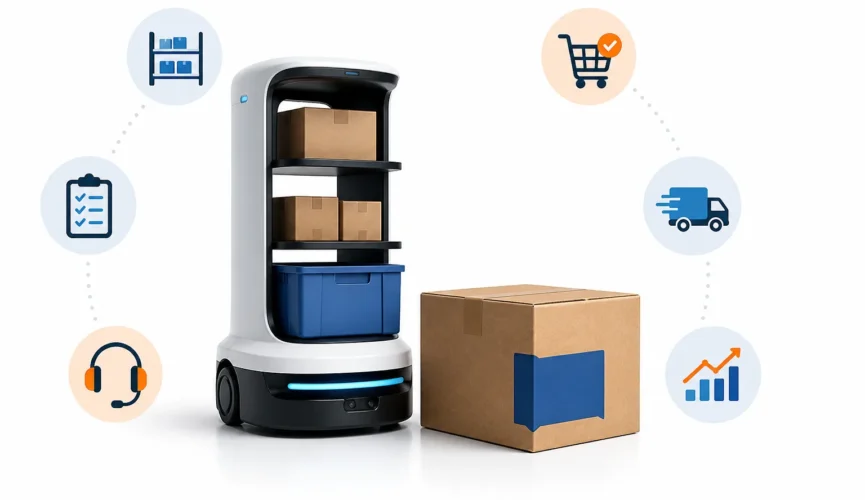
The Best Ecommerce Automation Tools for Shopify Stores include Shopify Flow for internal workflows, ShipStation for fulfillment, Inventory Planner for forecasting, Klaviyo for targeted email, Zendesk and Gorgias for support, MyWorks for accounting sync, and Mesa for external integrations. Shopify Flow is free with current plans, while third-party pricing and limits vary by tool and usage.
- Shopify Flow is free and included with current Shopify plans.
- ShipStation can import Shopify orders, create shipping labels in bulk, apply shipping rules, route orders, and return tracking information to Shopify.
- Inventory Planner uses historical sales data, seasonality, and sales trends to forecast future inventory demand.
- Klaviyo’s free plan supports up to active profiles, with SMS credits billed separately.
- MyWorks can sync Shopify order data with QuickBooks or Xero in real time.
What tasks can ecommerce automation tools handle in a Shopify store?
Shopify automation tools are apps and built-in Shopify features that act when a trigger occurs. The Best Ecommerce Automation Tools for Shopify Stores therefore start with repetitive work that has a clear event, response, and result. Inventory automation can track stock, process orders, alert a warehouse to pack and ship, and update customers with tracking information. Inventory tools can also monitor low stock, sync inventory across sales channels, forecast demand, and generate purchase orders.
Marketing workflows can run email, SMS, and social media campaigns. Customer-service automation can support order tracking, returns, FAQs, chatbot replies, and product recommendations. Accounting automation can enter transactions, reconcile accounts payable and receivable, and prepare financial statements. For businesses, entrepreneurs, agencies, and operations teams, the Best Ecommerce Automation Tools for Shopify Stores are the ones that match a specific repetitive workflow. The Best Ecommerce Automation Tools for Shopify Stores can be evaluated through the same lens used for no-code, low-code, and AI-agent projects: define the task before choosing the tool.

Which are the Best Ecommerce Automation Tools for Shopify Stores?
The Best Ecommerce Automation Tools for Shopify Stores depend on the job: Shopify Flow covers internal store workflows, while specialist tools extend fulfillment, marketing, support, inventory, accounting, or advertising. Shopify Flow supports inventory management, order processing, customer interactions, and back-office work without coding knowledge. It also supports custom logic and unlimited actions.
Klaviyo supports segmentation for targeted email campaigns, HubSpot Marketing Hub supports email, social campaigns, loyalty programs, and analytics, and Zendesk supports AI-powered chatbots, ticket routing, and self-service. ShipStation handles shipping and tracking, Inventory Planner forecasts demand, Gorgias performs Shopify actions from support conversations, and MyWorks syncs Shopify data with QuickBooks or Xero.
MESA connects Shopify with Google Sheets, CRMs, email platforms, and other services in one workflow. Shopify Flow also connects with tags, metafields, B2B, Slack, Google Sheets, Trello, and Asana. For broader external or multi-step work, third-party tools may suit you better. That is the practical distinction behind the Best Ecommerce Automation Tools for Shopify Stores. A no-code approach may suit a merchant who wants to configure workflows without coding. The Best Ecommerce Automation Tools for Shopify Stores should still be selected by use case, not by feature count.
How do leading Shopify automation tools compare in features, integrations, and ease of setup?
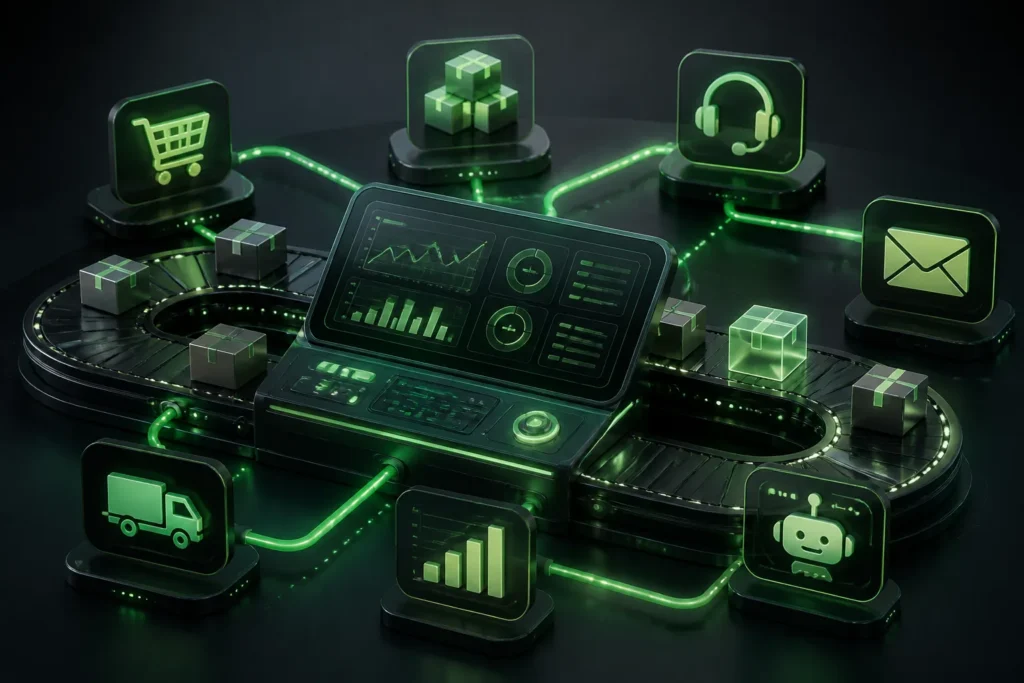
The Best Ecommerce Automation Tools for Shopify Stores differ most clearly in trigger depth, external connections, and the amount of setup you can manage comfortably. Shopify Flow offers nine core triggers and more than conditions, with additional triggers available through third-party app integrations. MESA is described as offering more than integrations and handling complex workflows that Shopify Flow cannot manage.
Klaviyo segments customers using behavior, preferences, and purchase history for targeted email campaigns. ShipStation can import Shopify orders, create labels in bulk, apply shipping rules, route orders, and send tracking information back to Shopify. Inventory Planner instead uses historical sales, seasonality, and sales trends to forecast demand. Gorgias can issue refunds, cancel orders, and edit customer information from support conversations.
Arigato Automation may require more complex setup than Shopify Flow and can feel technical to beginners. The Best Ecommerce Automation Tools for Shopify Stores are therefore not identical in ease of use. The Best Ecommerce Automation Tools for Shopify Stores should be compared against your workflow complexity, integration needs, and willingness to maintain rules.
How much do Shopify automation tools cost, and what usage limits or extra fees apply?
The Best Ecommerce Automation Tools for Shopify Stores range from included Shopify functionality to paid services with usage-based tiers. Shopify Flow is free and included with current Shopify plans, including Basic, Shopify, Advanced, and Plus. Third-party automation tools commonly use tiered pricing based on monthly tasks or runs, so your workflow volume matters.
Klaviyo’s free plan supports up to active profiles, while SMS message credits are billed separately from email plans. The documented starting prices are $49 per month for Adwisely and $36 per month for AdRoll; Criteo pricing is custom. No ledger figure establishes prices for every tool in this comparison, so those costs remain unknown here.
Advanced inventory forecasting, tax handling, and real-time accounting sync may require third-party apps. Unnecessary features can add cost, overwhelm a team, and create inefficiency. The Best Ecommerce Automation Tools for Shopify Stores should fit both task volume and operational capacity. The Best Ecommerce Automation Tools for Shopify Stores aren't automatically the cheapest option; they are the option whose documented scope matches the work.

How can a store owner connect an automation tool to Shopify and set up a workflow?
The Best Ecommerce Automation Tools for Shopify Stores usually follow a trigger-condition-action structure: an event starts the workflow, optional conditions narrow it, and an action changes a record or sends a message. Shopify Flow connectors can extend actions to Slack, Google Sheets, and other apps.
Start with a plug-and-play template, then customize it for your process; Shopify Flow offers hundreds of workflow templates. A marketing example could tag a first-time buyer and send a welcome email using triggers, conditions, and actions. For abandoned-cart recovery, Shopify lets you activate the feature in the Marketing section and choose a delay of one, six, or hours, or a full day.
Adwisely can be installed from the Shopify App Store and connected without a developer. Product-data sync can use API integration or feed export. The Best Ecommerce Automation Tools for Shopify Stores are easier to assess when you map the workflow before installing anything. The Best Ecommerce Automation Tools for Shopify Stores should then be tested with a narrow condition and a limited action before wider activation.

What risks or trade-offs should merchants consider, such as data access, errors, or platform limits?
The Best Ecommerce Automation Tools for Shopify Stores still need human oversight because poorly managed automation can reduce personalization, while new software can require learning, setup, and maintenance. Test every workflow before activation: a broken condition can send hundreds of incorrect emails or order updates.
Shopify Flow requests access to customer names, email addresses, phone numbers, and physical addresses. It also requests permission to edit orders and access order history and subscription contracts. Review those permissions against the action you intend to automate.
Shopify Flow only integrates with apps that have Flow Connectors, and it can be constrained when iterating through large datasets. Advertising workflows have separate risks: AdRoll relies on browser pixels for conversion tracking, while server-side tracking requires additional setup. Adwisely says some advanced features need historical data and that new stores see full optimization after to days of data collection. Two tools optimizing the same channel can create conflicts and waste budget. The Best Ecommerce Automation Tools for Shopify Stores require careful ownership and testing. The Best Ecommerce Automation Tools for Shopify Stores should not remove review from high-impact customer, order, or advertising actions.
How can merchants measure whether an automation tool saves time or increases revenue?
The Best Ecommerce Automation Tools for Shopify Stores should be measured against a baseline, not a promise. Record the weekly time spent on the task before automation, multiply weekly hours saved by the hourly rate, and compare that value with the tool’s monthly cost.
A cited beauty brand automated 80% of its routine tasks with Shopify Flow and saved four hours weekly. Treat that as a case-study benchmark, not a universal result. Separate operational outcomes—such as fewer manual inventory tasks, faster order handling, warehouse alerts, and tracking updates—from revenue outcomes such as retargeting or campaign performance.
Adwisely reports that merchants typically see a 15% to 40% improvement in ROAS within days, while noting that results vary. The Best Ecommerce Automation Tools for Shopify Stores make sense when the measured result exceeds the total cost and maintenance burden. Choose self-serve workflows for a narrow, repeatable task; consider a no-code or low-code tool for broader integrations; and seek an automation specialist when the workflow is complex or needs ongoing maintenance. The Best Ecommerce Automation Tools for Shopify Stores should support a decision, not replace one.

| Tool | Stated price or plan detail |
|---|---|
| Shopify Flow | free and included with all current Shopify plans |
| Klaviyo | free plan supports up to active profiles, and SMS message credits are billed… |
| Adwisely | from $49 per month |
| AdRoll | from $36 per month |
| Criteo | custom |
| Tool | Stated Shopify connection | Stated support automation or actions |
|---|---|---|
| Zendesk | Zendesk and Freshdesk can integrate with Shopify as ticketing systems | automates customer support with AI-powered chatbots, ticket routing, and… |
| Gorgias | perform Shopify actions from support conversations | issuing refunds, canceling orders, and editing customer information |
| Ochatbot | can embed on a Shopify website and use store data | answer FAQs or recommend products |
| Tidio | can embed on a Shopify website and use store data | answer FAQs or recommend products |
| Tool | Documented use | Connections | Stated pricing |
|---|---|---|---|
| Shopify Flow | Inventory, order processing, customer interactions, back-office workflows; custom logic and unlimited actions | Shopify tags, metafields, B2B, Slack, Google Sheets, Trello, and Asana | Free with current Shopify plans |
| Klaviyo | Behavior-, preference-, and purchase-history-based segmentation for targeted email | Shopify-connected marketing workflow; specific integration count is unknown | Free plan supports up to active profiles; SMS credits billed separately |
| HubSpot Marketing Hub | Email and social campaigns, loyalty programs, and analytics | Shopify and other ecommerce platforms | Price not stated in the ledger |
| Zendesk | AI-powered chatbots, ticket routing, and self-service | Shopify ticketing integration | Price not stated in the ledger |
| ShipStation | Bulk labels, shipping rules, order routing, and tracking updates | Shopify and multiple ecommerce platforms | Price not stated in the ledger |
| Inventory Planner | Demand forecasting using historical sales, seasonality, and sales trends | Shopify connection not specified in the ledger | Price not stated in the ledger |
| Gorgias | Refunds, cancellations, and customer-information edits from support conversations | Shopify actions from support conversations | Price not stated in the ledger |
| Mesa | Connects Shopify with external tools in one workflow | Google Sheets, CRMs, email platforms, and other third-party services | Tiered third-party pricing is common, but Mesa’s price is not stated |
| MyWorks | Real-time Shopify order-data sync with QuickBooks or Xero | QuickBooks and Xero | Price not stated in the ledger |
| Adwisely | Product-inventory sync, retargeting, and prospecting | Google Shopping, Facebook, Instagram, Google, Meta, and YouTube | From $49 per month |
| Ochatbot and Tidio | FAQs and product recommendations using store data | Embedded on a Shopify website | Price not stated in the ledger |
Key Takeaways
- Map each repetitive task to a trigger, condition, and action before choosing a tool.
- Use Shopify Flow for supported internal workflows and external tools when you need broader integrations or more complex multi-step automation.
- Check usage-based pricing, profile limits, SMS charges, and any custom pricing before committing.
- Test workflows with narrow conditions and retain human oversight for customer, order, and advertising actions.
- Measure weekly time saved and revenue outcomes separately, then compare the result with monthly cost and maintenance effort.
Frequently Asked Questions
What tasks can ecommerce automation tools handle in a Shopify store?
Shopify automation tools can handle inventory, orders, warehouse alerts, shipping updates, marketing campaigns, customer support, returns, and accounting tasks when configured around triggers and actions.
Which Shopify automation tools support order fulfillment, inventory, marketing, customer service, and accounting workflows?
Shopify Flow, ShipStation, Inventory Planner, Klaviyo, HubSpot Marketing Hub, Zendesk, Gorgias, MyWorks, Mesa, Adwisely, Ochatbot, and Tidio each support documented ecommerce workflows, though their functions differ.
How do leading Shopify automation tools compare in features, integrations, and ease of setup?
Shopify Flow provides nine core triggers and more than conditions, while MESA is described as offering more than integrations for complex external workflows.
How much do Shopify automation tools cost, and what usage limits or extra fees apply?
Shopify Flow is free with current Shopify plans, while third-party tools commonly charge according to monthly tasks or runs; Klaviyo’s free plan supports up to active profiles, with SMS credits billed separately.
How can a store owner connect an automation tool to Shopify and set up a workflow?
A Shopify workflow generally uses a trigger, optional conditions, and an action; Shopify Flow also offers hundreds of templates that you can customize.
What risks or trade-offs should merchants consider, such as data access, errors, or platform limits?
Merchants should test workflows before activation, maintain human oversight, and review requested permissions because a broken condition can send hundreds of incorrect emails or order updates.
How can merchants measure whether an automation tool saves time or increases revenue?
Measure time savings by multiplying weekly hours saved by the hourly rate and comparing that value with monthly software cost; treat reported advertising improvements as variable rather than guaranteed.