How to Build Your First n8n Automation Workflow means connecting a Gmail app-event trigger to a Slack action, testing each node, and activating the saved workflow after credentials and outputs work. n8n is available in cloud and self-hosted setups; its listed Pro plan costs $50 per month for 10,000 executions.
- Self-hosted n8n is free, while the cloud version requires payment.
- n8n’s Pro plan is listed at $50 per month with 10,000 executions and unlimited users.
- A Gmail app-event trigger can start a workflow after an email arrives in a specific Gmail folder.
- n8n’s Credentials manager stores service keys under a name so a node can select the relevant credential, and the source says secrets are encrypted and stored securely.
- Self-hosted workflows stop executing when the instance goes down, and missed schedules aren’t retroactively run.
What is n8n, and how do triggers, nodes, and connections work together in a workflow?
n8n is a visual workflow automation tool available in self-hosted and cloud setups. A workflow is an automated sequence made up of multiple nodes, with a trigger starting an execution and later nodes processing data in a specified order.
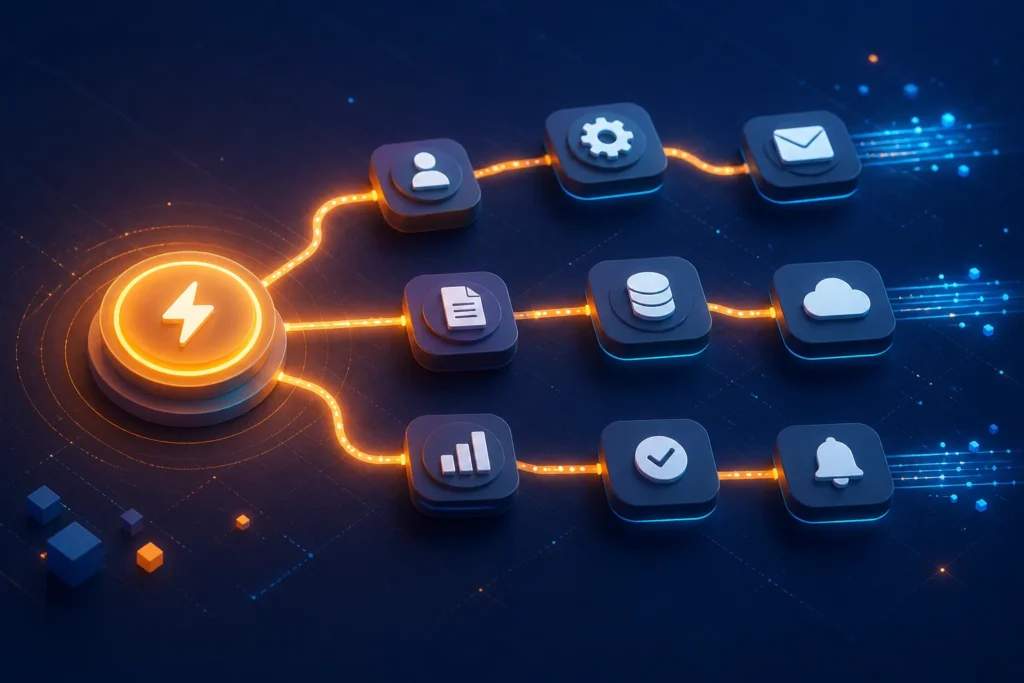
How to Build Your First n8n Automation Workflow starts on the workflow canvas, where trigger, action, and logical nodes are connected to define data flow. Trigger nodes listen for events or schedules, while regular nodes can fetch data or send information. Each connected node passes its output to the next node.
How to Build Your First n8n Automation Workflow can connect apps and services without requiring coding knowledge, while still allowing custom logic. Integrations support no-code automation, and n8n includes a dedicated AI Agent node for AI workflows.
For How to Build Your First n8n automation Workflow, think in three parts: an event, a sequence of nodes, and the data passed between them.

Should a beginner use n8n Cloud or self-host n8n locally, and what are the setup requirements and costs for each?
n8n Cloud reduces infrastructure responsibility, while self-hosting gives you a free software option but leaves infrastructure work with you. The comparison below lists prices and execution allowances stated by the sources; the figures use the currencies shown by those sources.
How to Build Your First n8n Automation Workflow locally can begin with Docker Desktop on Windows, macOS, or Linux. The Docker setup exposes n8n on port and creates persistent storage for workflows, after which you use the setup screen to create an owner account.
How to Build Your First n8n Automation Workflow can use the Community Edition without a software licence fee, but infrastructure still costs money; one small-deployment example specifies vCPU, GB RAM, and GB SSD, costing $10 to $15 AUD monthly.
How to Build Your First n8n Automation Workflow on self-hosted infrastructure also means handling updates, backups, uptime, and encryption-key protection, unlike Cloud’s managed updates, backups, and uptime.

How to Build Your First n8n Automation Workflow: Gmail email trigger to Slack message
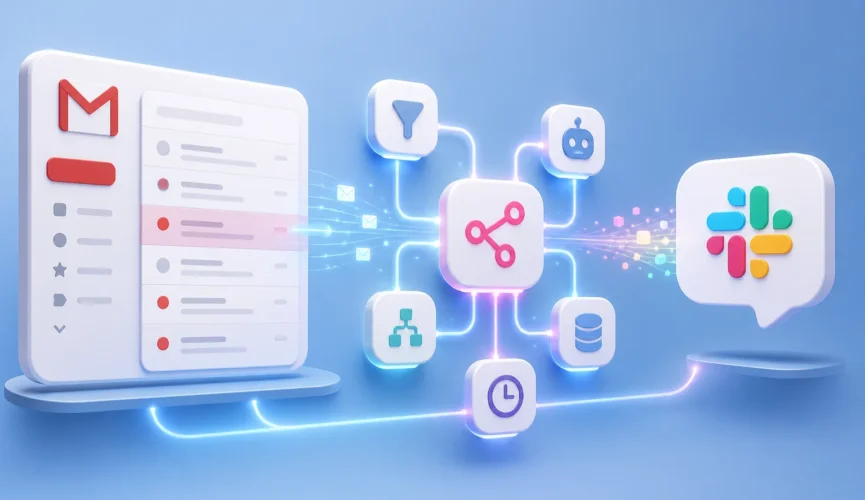
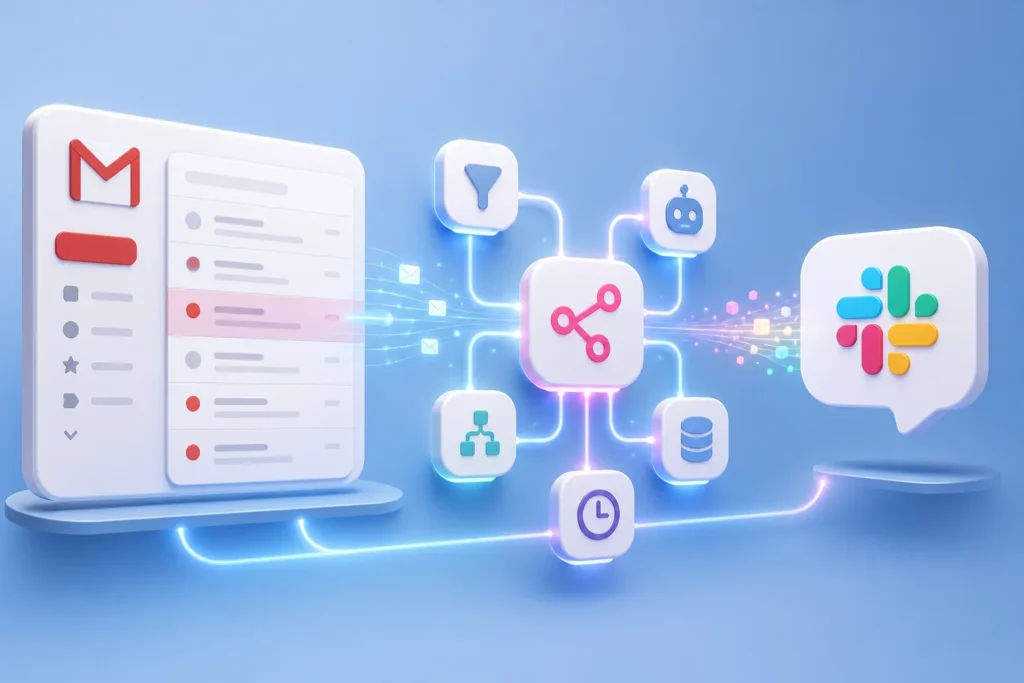
A Gmail-to-Slack notification is a small first workflow: specific incoming emails trigger Slack notifications. The example gives you one clear event, one action, and a visible result.
How to Build Your First n8n Automation Workflow begins with an app-event trigger. An app-event trigger starts when an app sends a signal after an event, such as an email arriving in a specific Gmail folder. Choose Gmail as the event source, then connect a Slack action node.
How to Build Your First n8n Automation Workflow follows a connected path from Gmail to Slack. Trigger nodes listen for events, action nodes perform work, and each node passes its output to the next node. Keep the first version small before adding more integrations or AI-agent steps.
For How to Build Your First n8n Automation Workflow, start with the email data you need in the Slack message rather than expanding the design too early.
How do you add and configure a trigger, connect an action node, and authorize the required app credentials in n8n?
Gmail and Slack credentials are configured through their respective app nodes, with Gmail authorized through Google sign-in and Slack connected by creating a credential.
How to Build Your First n8n Automation Workflow uses the trigger setup option “Run on an app event,” followed by Gmail selection. Create or choose the Gmail credential, complete Google authorization, and then create the Slack credential for the action node.
How to Build Your First n8n Automation Workflow benefits from n8n’s Credentials manager, which stores service keys under a name so you can select the relevant credential inside a node. The source says these secrets are encrypted and stored securely.
For How to Build Your First n8n Automation Workflow, add the trigger, connect Slack, choose the stored credentials, and save before testing. Connector steps that act in third-party services require authentication and may need further approval or configuration. Connected nodes pass each node’s output to the next, providing the supported basis for passing Gmail data into the Slack step.
How can you test a workflow with sample data, inspect node outputs, and fix common configuration errors before activating it?
A Manual Trigger gives you a controlled way to build and test before relying on automatic events. Run the workflow manually, node by node, and check each node’s output panel before connecting the next node.
How to Build Your First n8n Automation Workflow can use the HTTP Request inspection pattern: select Execute Node and check whether the output panel returns a JSON object. Inspecting the returned structure helps you see what the next node will receive.
How to Build Your First n8n Automation Workflow may expose configuration errors before activation. A reported Simple Memory error says that no session ID was found; the suggested fix is to select the Session ID that appears. A model-related error requires selecting an actual model version, with gpt-4 and gemini-pro given as examples.
For How to Build Your First n8n Automation Workflow, validate one or two workflows before migrating a full workload, and test with messy, inconsistent data early.
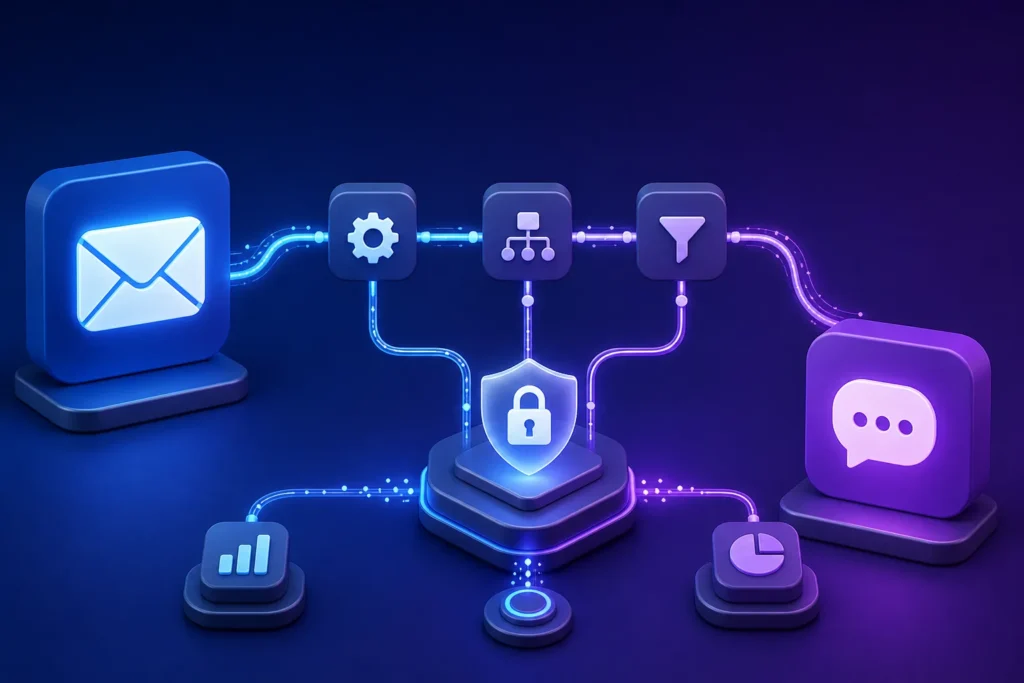

What can go wrong when a workflow runs automatically, and how can filters, error handling, and credential security reduce those risks?
Filters and IF nodes reduce unwanted processing by limiting which data continues. A filter allows only matching data through, while an IF node separates items into true and false branches.
How to Build Your First n8n Automation Workflow should account for failed queries, unresponsive APIs, unexpected data formats, and imperfect input before activation. Adding an error workflow from the beginning helps address failures caused by imperfect data.
How to Build Your First n8n Automation Workflow on a self-hosted instance stops when that instance goes down; webhook events may be missed, and missed schedules aren't retroactively run.
For How to Build Your First n8n Automation Workflow, define how credentials are stored and protected. n8n stores credentials securely and encrypted, while the N8N_ENCRYPTION_KEY must be backed up because losing it makes stored credentials inaccessible.
Use automated daily database dumps stored off-server, retain days of backups, and test restores quarterly.

After activating a first workflow, how can you monitor its executions and adapt it to handle additional conditions or actions?
n8n activates a workflow after you save it and toggle it on from the workflows overview. Activation makes the workflow live to respond to real-world triggers.
How to Build Your First n8n Automation Workflow should be monitored through the Overview page and execution records. The Overview page summarizes workflows, credentials, and executions, while execution monitoring should expose errors and results.
How to Build Your First n8n Automation Workflow can be operated more carefully with an error workflow, uptime monitoring, log aggregation, and execution-data pruning so old records don't cause indefinite database growth.
For How to Build Your First n8n Automation Workflow, add conditional branches and additional nodes as requirements grow. Changes to a connected database structure, API endpoint, or response format may require adjustments. Conditional branches are also a route to more tailored workflow behavior.
Automation & AI Agent Desk focuses on practical workflow automation, integrations, AI agents, and business process automation; those themes provide context for extending a tested n8n workflow.

| Offering and source | Stated price/cost | Execution allowance |
|---|---|---|
| Self-hosted n8n (codecademy.com) | self-hosted n8n is free | — |
| n8n Pro plan (xray.tech) | $50 per month | 10,000 executions |
| n8n Community Edition (osher.com.au) | no software licence fee; self-hosting requires paying for infrastructure, which… | — |
| n8n Cloud Starter (osher.com.au) | around $35 AUD monthly | 2,500 executions |
| n8n Cloud Pro (osher.com.au) | roughly $80 AUD monthly | 10,000 executions |
| Offering | Stated price or cost | Execution allowance | Additional detail |
|---|---|---|---|
| Self-hosted n8n | Free software | Not stated | Infrastructure required; example small deployment costs $10–$15 AUD monthly |
| n8n Pro plan | $50 per month | 10,000 executions | Unlimited users |
| n8n Community Edition | No software licence fee | Not stated | Infrastructure required; most-business estimate is $10–$100 AUD monthly |
| n8n Cloud Starter | Around $35 AUD monthly | 2,500 executions | Cloud offering |
| n8n Cloud Pro | Roughly $80 AUD monthly | 10,000 executions | Cloud offering |
Key Takeaways
- Start with a Gmail-to-Slack workflow that has one clear trigger and one visible action.
- Use a Manual Trigger and inspect each node’s output before enabling automatic events.
- Choose Cloud or self-hosting based on whether you want to manage infrastructure, backups, updates, and uptime.
- Protect credentials and back up the N8N_ENCRYPTION_KEY in a self-hosted setup.
- Monitor executions, errors, and results before adding branches, integrations, or AI-agent steps.
Frequently Asked Questions
What is n8n used for?
n8n is a visual workflow automation tool available in self-hosted and cloud setups. A workflow combines trigger and regular nodes to process data in sequence.
Should I use n8n Cloud or self-host n8n?
A beginner can start with n8n Cloud for less infrastructure management or use the free self-hosted software while paying infrastructure costs. The best choice depends on your willingness to manage updates, backups, and uptime.
How do I connect Gmail to Slack in n8n?
A Gmail app-event trigger can start a workflow when an email arrives in a specific folder, and a connected Slack action can send a notification.
How do I test an n8n workflow?
Use a Manual Trigger while building and testing, then run the workflow node by node and inspect each output panel before activating automatic events.
How do I add conditions to an n8n workflow?
An IF node separates items into true and false branches, while a filter allows only data matching specified criteria to continue.